Sea Trout
Salmo trutta
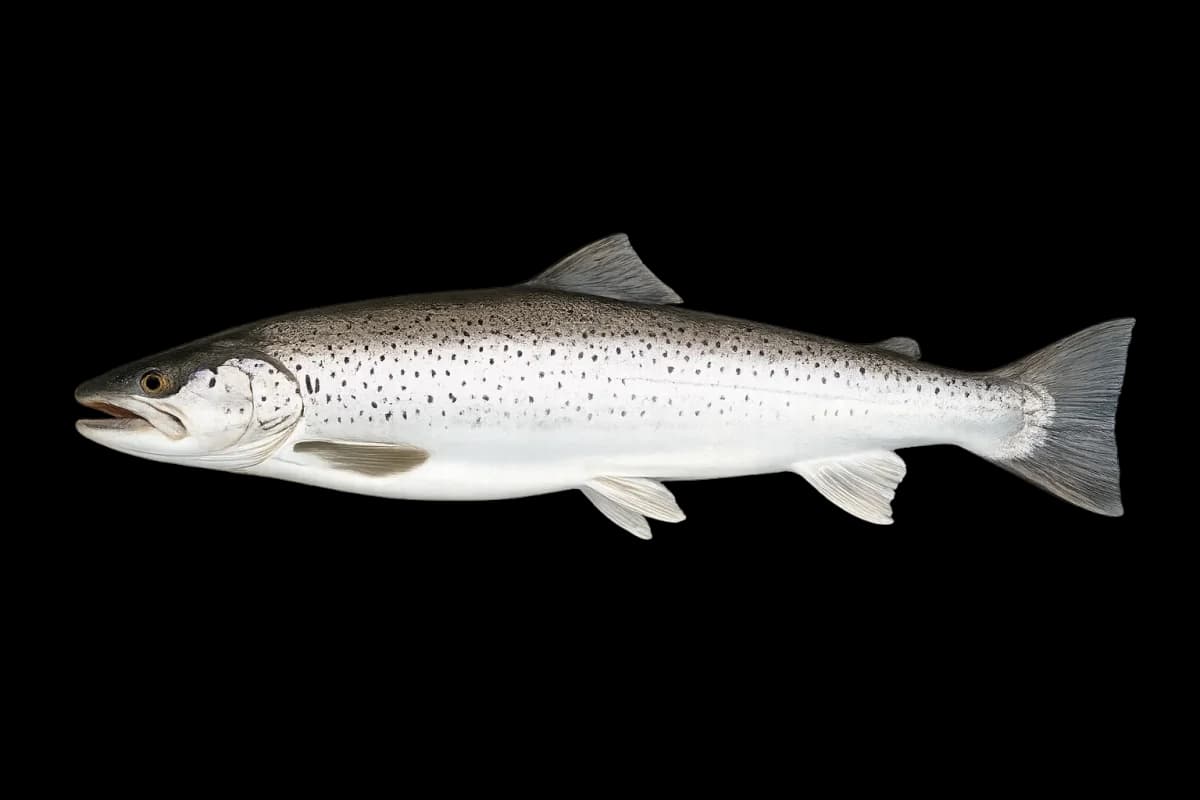
The ANADROMOUS (sea-running) form of brown trout (Salmo trutta) – one of Norway's most popular coastal sport fish. ID features: SILVER body in the sea (the scale pattern is 'lost' during migration), stockier body than salmon, shorter wrist, BROAD SQUARE TAIL FIN (not forked like salmon), darker upper side with many small SPOTS also on the gill cover. Maximum often around 75-90 cm in the sea, large individuals over 5 kg. Anadromous: spawns in fresh water (October-December on gravel in running water), feeds at sea – shorter marine phase than salmon, often within the same fjord system. Patrols shallow 0-10 m in brackish water, river mouths, EELGRASS BEDS, kelp and wrack edges, sand and mud bays and current edges. Eats shrimp, small fish (gobies, sprat, sandeel), polychaetes and sea slaters. EXPOSED to SEA LICE in fjords with fish farms (IMR). LC – of least concern on the 2021 Norwegian Red List, but local stocks can be heavily pressured. REGULATED – minimum size 30 cm in Nordland/Troms/Finnmark, 35 cm in the rest of the country. 100-metre rule plus river-mouth protection zones.
Illustration: Sakke Yrjölä · converted to WebP
Habitat preferences
Usually in near the surface along ridges and edges over varied coastal bottom.
- Usually in near the surface
- Moves between bottom and open water
- Gentle to moderate slopes
- Favours ridges and edges
- Thrives on sand, gravel and mud
Fishing methods
Bait & Equipment
- •Fly rod 5-7 weight with floating or intermediate line
- •Spinning rod 2.40-2.70 m, 5-25 g casting weight
- •Spinning reel 2500-3500
- •Braided line 0.10-0.15 mm with fluorocarbon leader 0.20-0.28 mm
- •Waders or wading boots for long shallow shorelines
- •Polarised sunglasses to see fish and structure
Season & Spawning
Winter: lower score, but can be GOOD on mild days in brackish water and over dark bottoms. Early spring: VERY HIGH score in shallow bays as the sun warms the mud. Spring: HIGH score on shrimp, polychaetes, sea slaters and eelgrass. Summer: move to current, oxygen, night and cooler water. Autumn: HIGH score before the spawning run (but check protected zones!). Spawning period (September-December in many watercourses): STRICT local rules, kelts must be released.
Anadromous: spawns in FRESH WATER (October-December) on gravel beds in running water. Adults return to the sea after spawning (can spawn several times – unlike Pacific salmon). Kelts are spawned fish that return emaciated to the sea – release them GENTLY. Local strains – each watercourse has its own genetic stock.
Fishing tips
- ✓Sea trout = shallow 0-10 m + EELGRASS/kelp + brackish water + baitfish/shrimp + dawn/dusk
- ✓ID features: BROAD tail fin + spots on the GILL COVER (separates from salmon)
- ✓REGULATED: minimum size 30 cm in N-Norway / 35 cm in the rest + 100 m zone at rivers/streams
- ✓Check RIVER-MOUTH PROTECTED ZONES on Lovdata or county governor before fishing near a river or stream
- ✓Onshore wind + dusk + eelgrass edge = classic hot spot
- ✓EELGRASS toggle gives a CLEAR habitat bonus – sea trout patrol along the edge
- ✓Kelts (emaciated spawned fish) MUST be released gently
- ✓SEA LICE risk in fjords with fish farms - sea trout is vulnerable due to longer marine phase
- ✓Spring mud/brackish + summer current/oxygen + autumn pre-spawn run (check rules)
- ✓Gentle handling: wet hands, short time out of water, circle hooks reduce deep hooking
Regulations (Fiskeridirektoratet)
- LC — least concern on the 2021 Norwegian Red List, but local stocks can be under pressure.
- AT SEA: as a main rule, rod and hand line from shore and boat is open all year (FOR-2021-03-15-797 § 2) — the area and seasonal bans below take precedence.
- SPRING BANS: 1 March–30 April in the Ryfylke fjords, Hardangerfjord and Møre og Romsdal (except Smøla); 1 March–31 May in Trøndelag, and in Nordland from a boat (Skjerstadfjorden until 30 June).
- YEAR-ROUND BAN for sea trout: Sunndalsfjorden, Tingvollfjorden, Bergsøyfjorden and Batnfjorden inside the E39.
- NO-FISHING all year: Indre Oslofjord, Færder and Ytre Hvaler (covers salmon and sea trout from 1 January 2026).
- RIVERS: the national spawning and winter closures apply in watercourses and do not close rod fishing at sea — local sea bans still apply.
- MINIMUM SIZE: 30 cm in Nordland/Troms/Finnmark, 35 cm in the rest of the country (FOR-2003-06-20-736 § 3).
- At rivers covered by section 3 of the sea regulations: no fishing within 100 m of the river–sea boundary. Shore rod and hand line are exempt: salmonids if that species is open, sea fish if the river is open for salmonids.
- ESTUARY PROTECTION ZONES: outside anadromous watercourses — check Lovdata and the county governor.
- Exposed to salmon lice in fjords with fish farms (IMR) — spends longer at sea than salmon.
- Winter kelts (spent, emaciated spawners) should be released carefully — a recommendation, not a national requirement at sea.
- Rules vary locally — always check the county governor and Lovdata before fishing.
Tourists (neither Norwegian citizens nor resident in Norway): hand-held gear only, such as rod and hand line, and selling your catch is prohibited.
FjordSpot shows selected fishing rules. You are responsible for checking and following the rules that apply where you fish.
How to use FjordSpot to find Sea Trout
- Open the map and centre on the fjord you want to explore
- Tap “Find the fish” and choose Sea Trout
- FjordSpot calculates an HSI score (0–100) from depth, seabed, temperature, season and marine habitat data
- A high score = a likely good spot for Sea Trout right now